
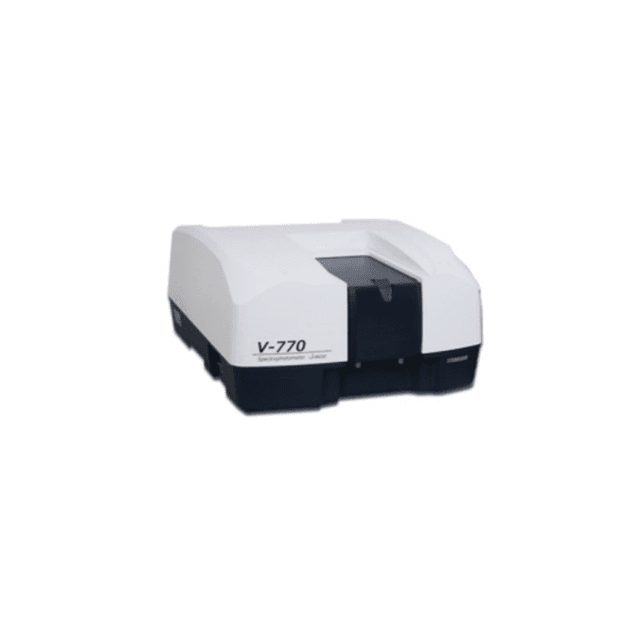
Technical Specifications
Model Name
V-770ST UV/VIS /NIR Spectrophotometer
Manufacturer
JASCO International Co. Ltd., Japan
UV-VIS-NIR Spectroscopy with IRS
About the UV-VIS-NIR Spectroscopy Facility
The V-770 Double Beam UV-Visible/NIR Spectrophotometer (JASCO) is a high-performance analytical instrument designed for precise and stable measurements across a wide spectral range from UV to near-infrared (≈190-2700 nm). It features a single-monochromator, double-beam optical system that ensures excellent baseline stability, low stray light, and high signal-to-noise ratio, supported by a PMT detector for UV-Vis and a Peltier-cooled PbS detector for NIR. The instrument offers flexible bandwidth selection, fast scanning speeds, and seamless control through Spectra Manager™ software, making it suitable for both routine and advanced analyses. Applications include optical characterization of semiconductors and nanomaterials, band-gap estimation, thin-film and coating analysis, diffuse and specular reflectance studies, quantitative analysis of solutions, and material research in physics, chemistry, materials science, pharmaceuticals and environmental studies.
Salient Features
Wavelength Range: 190 - 2700 nm
Spectral Bandwidth: Variable across multiple settings for UV-Vis and NIR
Scanning Speed: Up to 4000 nm/min (~8000 nm/min preview)
Detectors: PMT (UV-Vis), Peltier-cooled PbS (NIR)
Optical System: Single monochromator, fully symmetrical double beam
Advanced Software Control: JASCO's Spectra Manager™ software
Flexible Measurement Modes: Supports standard modes such as absorbance, transmittance and reflectance (specular and diffuse), making it suitable for liquids, solids, powders and films.
Low Stray Light & Noise: Excellent stray light performance and low baseline noise ensure high measurement accuracy.
High-Performance Scanning: Variable spectral bandwidth settings allow flexibility from narrow to broader bandwidths.
Key Applications
"Spectral analysis enabling precise characterization of materials, films, solutions, and functional systems"